"AI" is on the front of almost every app now, workout trackers included — and most of the time it means very little. But in a handful of apps, AI genuinely changes how you train: it writes up your session, builds workouts on request, or adjusts your weights for you. Here are the best AI workout apps in 2026, and, just as importantly, what their AI actually does.
We make one of these (Joti), so we know the space well — and we've been straight about where each app's AI helps and where it doesn't.
What "AI" should mean in a workout app
Before the list, a quick filter. Useful AI in a tracker does at least one of these:
- Explains your training. Turns a wall of numbers into a plain-English summary — what improved, what stalled, what to do next.
- Builds things for you. Generates a workout or finds an exercise from a description and the equipment you own.
- Adapts over time. Adjusts weights, reps or session selection based on your real results, not a generic template.
Anything that's just a chatbot bolted onto a logging screen doesn't make the cut.
The best AI workout apps in 2026
1. Joti — best all-round AI training partner
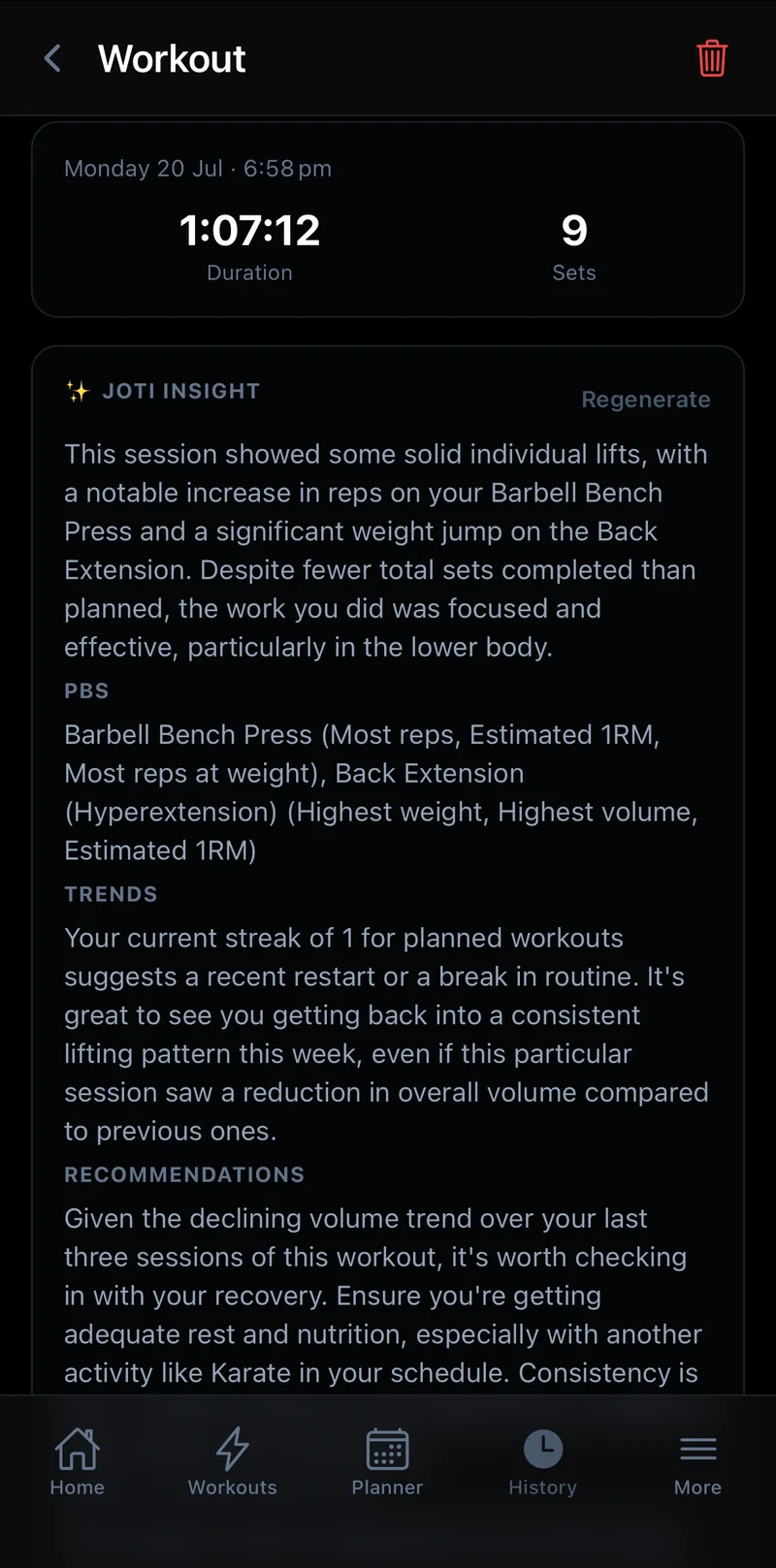
Joti builds AI into the moments that matter instead of hiding it in a chat tab. Finish a session and it writes an instant summary: what improved, which personal bests you hit, and whether recovery needs attention. Describe a program in plain English and it finds a match or builds a new workout around your equipment. Can't name an exercise? Describe it and Joti finds or creates it. And with auto progression on, it raises your weights or reps session over session based on what you actually logged — using only the equipment you own. Joti also goes a step further than any tracker on this list: it's a listed app in ChatGPT's own app directory, and also connects to Claude or another compatible AI assistant — sign in from your assistant of choice and let it work with your real training data directly — pulling your stats and history, building or duplicating a workout, and managing your training calendar, all through natural conversation, with every AI-made change logged and one-tap undoable. All of it sits on top of fast, ordinary set logging, so you get the AI without giving up a clean tracker.
AI does: session summaries, workout & exercise generation, automatic progression, and direct AI-assistant connectivity (Claude, ChatGPT & more). Best for: lifters who want feedback and guidance woven into everyday tracking.
2. Fitbod — best for auto-generated sessions
Fitbod's algorithm assembles each workout for you, taking into account the muscles you've recently trained, your available equipment and your recovery. If your sticking point is deciding what to do that day, it removes the decision entirely.
AI does: generates each session for you. Best for: people who want to just show up and lift. Watch out for: less control if you like running your own program, and it's subscription-first.
3. Setgraph — best AI planner for freestyle lifters
Setgraph leans on AI to build personalised programs from your goals, schedule and equipment, while keeping an exercise-first, freestyle logging style. A good middle ground if you want some AI structure without a rigid plan.
AI does: generates personalised programs. Best for: lifters who train by feel but want an AI starting point.
4. Established loggers adding AI (Jefit, and others)
Several long-running trackers such as Jefit have started layering AI-driven suggestions and progressive-overload prompts onto their large libraries and routine tools. If you already live in one of these apps, it's worth checking what AI features have arrived — though for most, AI is an add-on rather than the core of the experience.
AI does: varies — often overload suggestions on top of a big library. Best for: existing users who want AI without switching apps.
How to choose
Decide what you want the AI for. If it's feedback and generation built into daily tracking, start with Joti. If it's "just tell me what to do today", try Fitbod. If you want an AI plan but freestyle logging, look at Setgraph. Nearly all offer a free trial, so test the AI on a real week of training before you commit — a summary or generated workout is easy to judge once it's describing your sessions.
Want the wider picture, AI or not? See our roundup of the best workout apps for 2026.
Frequently asked questions
What is an AI workout app?
An AI workout app uses artificial intelligence to do more than record your sets — for example, writing a summary of your session, generating a workout from a description or your available equipment, adjusting your weights automatically based on your results, or letting an AI assistant like Claude or ChatGPT work with your training data directly. Joti does all of these; many popular trackers still focus purely on manual logging.
Which workout app has the best AI?
It depends what you want the AI for. Joti is strongest for AI feedback, workout/exercise generation built into everyday tracking, and direct connectivity to AI assistants like Claude and ChatGPT; Fitbod is strongest for auto-generating each session from your recovery and equipment. Try both free and see which fits how you train.
Are AI workout apps free?
Most are free to start. Joti is free to download and includes a 1-month free trial of everything, including its AI features. After a trial, AI features are often part of a paid tier — in Joti the AI training partner is included, not a separate add-on.
Can AI replace a personal trainer?
No. AI is great for logging feedback, spotting trends and removing planning friction, but it does not watch your form in person or coach you like a qualified trainer. Think of an AI workout app as a smart training partner, not a substitute for professional coaching when you need it.
Can I use Claude or ChatGPT with a workout app?
With Joti, yes — sign in from Claude, ChatGPT or other compatible AI tools and let them pull your stats and history, build or duplicate a workout, and manage your training calendar through natural conversation. Every AI-made change is logged, badged, and one-tap undoable. Most other trackers on this list have no equivalent AI-assistant connection.